By Robert Roth, Haiti Action Committee [excerpts]
As the world reels from the devastating U.S.-Israel war on Iran and Lebanon, and as the U.S.-backed Israeli genocide continues in Gaza and the West Bank, the Trump Administration’s plan to assert its dominance over the Americas is also moving forward at an unprecedented pace. Having kidnapped Venezuelan President Nicolas Maduro and his wife and colleague, Cilia Flores, and taken control over Venezuela’s oil reserves, the U.S. is now salivating over the prospect of toppling the socialist government of Cuba. On March 16, Trump announced that he “could take Cuba whenever I want”.
Old-fashioned U.S. imperialism, with no cover, is back in force. And it isn’t just words: the U.S. has ratcheted up its blockade of Cuban ports, strangling the island nation by attempting to eliminate its fuel supply. Over 15,000 U.S. troops are now stationed throughout the Caribbean, with a concentration in Puerto Rico. As of March, the long-standing supply of Venezuelan oil to the Cuban government has ceased. Even Cuba’s vaunted medical support for countries in the Americas has come under withering attack.
Despite proclamations of victory in the Iran war, the U.S. and Israel are facing unforeseen consequences, and were unprepared for the level of Iranian self-defense, which has rattled the world economy and sent shock waves throughout West Asia. The U.S. has been attempting to destroy Cuba ever since the Cuban Revolution without success. But as history has shown, an empire in crisis can and will unleash terror around the world.
The Crisis in Haiti
For Haitians, this is an all-too-familiar scenario. The kidnapping of President Maduro and his wife followed the script of the 2004 U.S.-orchestrated coup against the democratically elected progressive government of Hauti’s President Jean-Bertrand Aristide. On February 29, 2004, U.S. Marines kidnapped President Aristide and his wife and colleague, Mildred Aristide, and deposited them at a French military base in the Central African Republic, leading eventually to a seven-year forced exile in South Africa.
In the aftermath of the coup, thousands of Haitians were killed, raped, or terrorized into exile. Reinforced by a violent UN military occupation, the coup brought in a series of corrupt, drug trafficking right-wing governments eager to sell the country’s land and resources to multinational corporations.
These U.S.-imposed governments, and the tiny Haitian elite they serve, were responsible for empowering paramilitary death squads, called “gangs” in the U.S. media, to wipe out opposition and protect their assets, plunging Haiti into an ever-deepening crisis.
Haitian Civilians: Caught Between A Rock and A Hard Place
In the last year alone, approximately 8100 people have been killed in Haiti– primarily by paramilitary violence. Armed groups operate with impunity. In late March, the “Gran Griff” death squad, part of the Viv Ansamn paramilitary federation, massacred over 80 people in Haiti’s agricultural center. Roads throughout the country remain blocked, people cannot access markets, and 1.4 million people have become internal refugees. Hospitals have been forced to close after being targeted by paramilitaries. Sexual violence against women and children has become the norm.
According to UN stats, 5.7 million Haitians face “high levels of acute food insecurity”, including more than 1.2 million children under age 5. This is why Fanmi Lavalas, the party founded by former Pres. Aristide, has labeled this a “slow-motion genocide.”
The current Haitian government signed a 10-year multi-million dollar contract with Erik Prince’s infamous mercenary group, Vectus Global. Formerly known as Blackwater, it was responsible for the Nisour Square Massacre in 2007 during the Iraq War. Vectus Global is now carrying out “anti-gang operations” with Haitian police that have resulted in the killing of over 1100 people, many of them civilians, in densely populated parts of Port-au-Prince. The government also signed an $85.4 million contract with foreign private for-profit prison firms to build three new prisons, in a country that needs money for health care and education, not more prisons.
February 7, a temporary presidential council dissolved, leaving only US-backed prime minister Alix Didier Fils-Aime, in charge. When widespread opposition to Fils-Aime surfaced, US Secretary of State Marco Rubio warned Haitians that there would be “grave consequences” if Fils-Aime were removed from power. A US warship sits off the coast of Haiti and a UN force of 5,500 is gearing up to deepen the occupation of Haiti and oversee new elections.
Envisioning a New Haiti
Haitians have always resisted tyranny. They overthrew slavery, defeated Napoleon’s army, and declared the world’s first Black republic in 1804. Today, communities have risen to defend themselves from paramilitary attacks, despite the high-powered weapons in the hands of the death squads. Women’s groups have mobilized to provide support for the survivors of gang rapes. The University of the Dr. Aristide Foundation (UNIFA), taken over by the U.S. military after the 2004 coup and reopened when the Aristides returned to Haiti in 2011, continues to graduate doctors, nurses, lawyers, agronomists, dentists, engineers, and physical therapists amid daunting challenges. UNIFA has now opened a teaching hospital. Activists at the local level are building capacity and resistance. A new Haiti can be envisioned through the prism of these grassroots efforts.
Defend Haitian Refugees
Haitians in the US are also in the crosshairs. Throughout their 2024 election campaign, Trump and Vance demonized Haitians, falsely accusing them of eating their neighbors’ pets. This racist lie fueled anti-Haitian attacks throughout Ohio. Shortly after Trump’s inauguration, the DHS tried to end Temporary Protective Status (TPS) for over 350,000 Haitians.
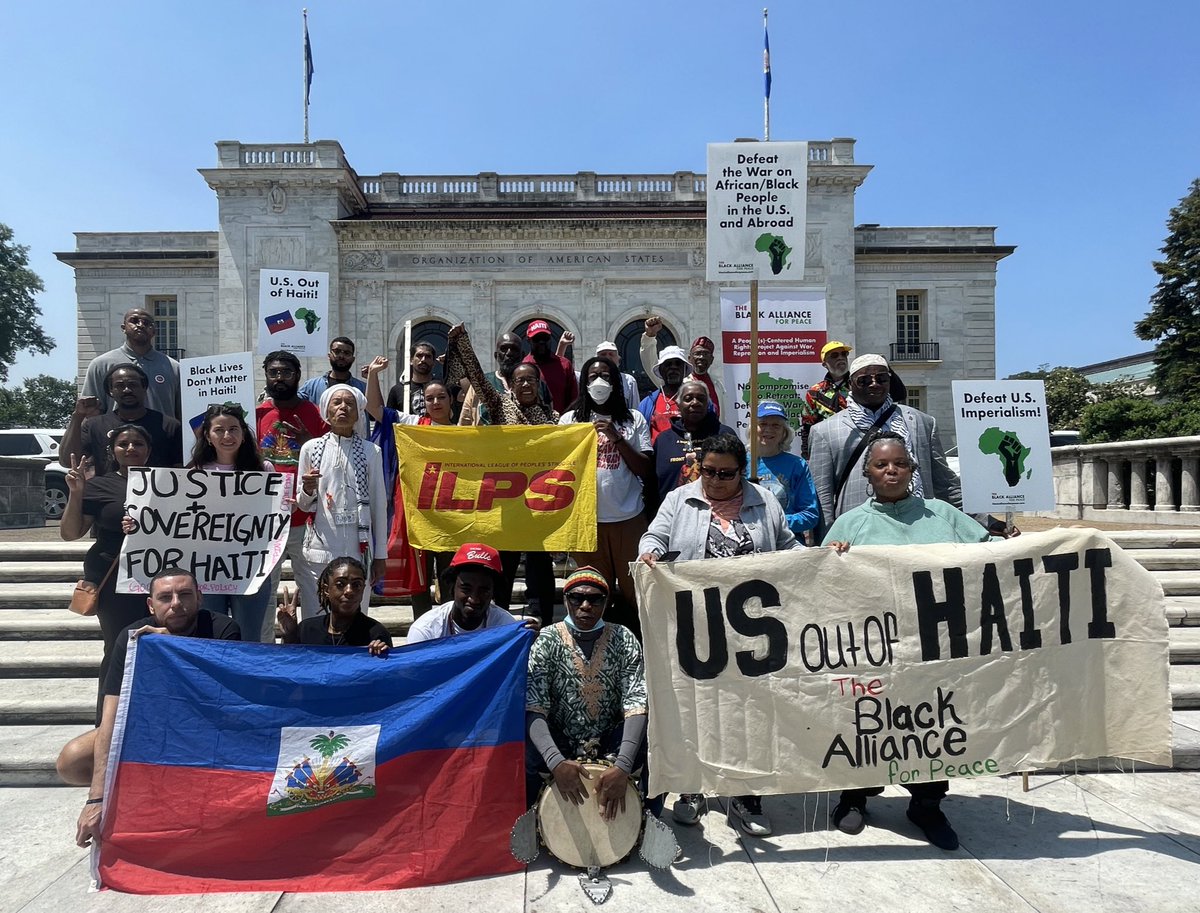
On March 6, the U.S. Court of Appeals upheld a ruling that terminating TPS for Haiti was unlawful and based on “racial animus”. This ruling allows beneficiaries to maintain their status and keep their work permits for the moment. But Trump has already filed an appeal to the Supreme Court, which has often ruled against refugees. In response, some in Congress put forward an initiative aimed at extending TPS for Haitians for another three years. Activism in support of Haitian refugees and the grassroots movement in Haiti is critical. Join us — From Haiti to Venezuela to Cuba and Puerto Rico – One Struggle/One Fight!
To support grassroots projects in Haiti, please donate to the Haiti Emergency Relief Fund: www.haitiemergencyrelief.org You can reach the Haiti Action Committee at PO Box 2040, Berkeley, CA 94702; www.haitisolidarity.net.